AYU WHITMORE

EVERYDAY RADICAL
“Everything you have been told about creativity is wrong.” (Mould, 2018, blurb)


"A large part of seeing depends upon habit and convention."
- John Berger
As illustrators, our ways of seeing are deeply shaped by the values we've inherited, whether from family, education, media, or culture. It is vital to notice these inherited frameworks to question whether they truly serve us. What might it mean to imagine your creative self living by entirely different values and to envision new ways of being and making that are not defined by dominant systems?
Prevailing narratives of productivity, efficiency, perfection, and individualism often confine our creative practice. Only a slave quantifies its existence through productivity. Instead we should explore alternative approaches of slowness, noticing, care, ritual, and spontaneity.
In an attempt to decentre our Western authority in artmaking, I speak in Daoist adjacent philosophy. For Zhuangzi, to be radical is to free oneself from rigid modes of thought and return to a natural, spontaneous way of being. Radicalism, in this sense, is not opposition but acceptance, a recognition that all things change. Ideas such as Wu Wei (無為, “doing less, not more”) and Ziran (自然, “returning to one’s natural way”) may serve us, even if in opposition to what the neoliberal system demands of us.
By questioning “default” ways of seeing and living, this project aims to re-centre the everyday as a site of quiet resistance and renewal.

John Berger reminds us that “The relation between what we see and what we know is never settled” (Ways of Seeing, 1972). In a world moving at high speed, learning to slow down, question your defaults, and pay attention to the overlooked isn’t just philosophical, it’s a core creative skill. This project helps in exploring that unsettled space. When we disrupt our habits, notice the unnoticed, or shift our routines even slightly, we begin to see the world differently, and when we see differently, we draw differently. Illustration thrives on subtle acts of observation and imagination. Small everyday experiments can radically transform visual language, deepen personal voice, and expand the kinds of stories an individual is able to tell. The brief trains creative intuition in the most direct way possible: through lived experience, tiny disruptions, and attentive looking. To illustrate well, we must first learn to see well.
What better way to question my defaults and rethink the way I see the world than through film? The Pervert's Guide to Ideology strongly connects to the themes of Everyday Radical, particularly its focus on questioning the invisible structures shaping everyday life. Slavoj Žižek argues that ideology is not simply something imposed on us externally, but something embedded within our habits, pleasures, and perception of reality itself. Even when we believe we are acting freely or escaping systems of control, we often remain deeply inside them.
Contemporary ideology no longer primarily functions through duty or obedience, but through pleasure and personal fulfilment: “Be yourself. Realise your true potential.” It's reminiscent of modern digital culture and the attention economy, where individuality itself can become commodified.
Žižek’s discussion of how ideology shapes our “spontaneous relationship” to the world made me reflect on how everyday behaviours can feel natural despite being shaped by larger systems. Here it is evident why small acts of attention, slowness, and reflection prove to be subtle forms of resistance against cultures structured around distraction and passive consumption.
The film poses the idea that confronting ideology can be painful rather than liberating in a simple sense. The process of becoming aware of how our habits and desires are shaped can destabilise comforting illusions about individuality and freedom.
WE TOO ARE TRAPPED IN A SYSTEM – WE CANNOT SEE BEYOND IT – BUT THERE IS MORE OUT THERE
- Adam Curtis
DECOLONISATION

Theatrical release poster © P Guide Ltd & Zeitgeist Films. (The Pervert's Guide to Ideology (2012)).

Skeptic challenges
We were given various sets of tasks to choose from that would challenge our everyday in small, incremental steps. Our visual work should come from what the challenge felt like. The feelings and moments are the material.
I chose the skeptic-inspired tasks. I'm self-aware enough to know I overthink myself into delirium, often over nothing, but rarely challenge myself into questioning this.
SKEPTIC-INSPIRED CHALLENGES
(Questioning beliefs, suspending judgement, noticing assumptions)
1. The Assumption Log
Write down every assumption you make for 24 hours (“That person is annoyed,” “This will be boring”). At night, question each: was it true?
2. One Day Withheld Judgement
Whenever you catch yourself forming an opinion, pause and say:“I don’t actually know.” Notice what that creates.
3. Reverse the Opinion
Take a belief you hold strongly, and argue the opposite for 5 minutes in writing. Not to change your mind — just to stretch it.
4. Doubt the Default
Whenever you do something on autopilot, ask: “Why this? Why now? Why like this?” See where the questioning leads.

I came across a stand run by the Revolutionary Communist Party on my way back from a lesson. Normally I walk straight past these sorts of things, encounters always prompt the same thought, what difference do they think they'll make? "Communism" is such a tainted word they'll seldom bring in socialists, it seems doomed from the start. If anything they risk further damaging the broader left's reputation further.
This time I caught myself. I witheld judgement. I've always considered myself left-wing, but I see communism as anachronistic, not a viable economic model, nor do I believe the RCP will be able to gain meaningful influence, especially considering the growing reactionary climate in the UK. Not even Sultana and Corbyn's Your Party would openly associate with them.
Still, I don't have an answer. And I'm still growing and maturing, so what do I know? Well I know the left does lack a credible alternative, and Labour’s polling continues to deteriorate. So, rather than sashay past I approached the stand and listened to what they had to say. To their credit, the people there are doing more than I am. My political grievances rarely leave the confines of a keyboard. In the end I bought a newspaper and a magazine featuring Constructivist art on the cover. Their sincerity was unmistakable, their hearts in the right place.


If the Assumption Log taught me anything, it’s that I care far too much about other people’s opinions. Almost all of the assumptions I recorded centred around what others might be thinking, primarily about me. Moving forward, I want to learn to relax more, both for the sake of my mental health and my creative practice. It’s a mindset that can very quickly become self-destructive.
"How many angels can dance on the head of a pin?"
For my reversal of opinions task, I decided to write about idealism.
The phrase above is one I resonate with. Historically, it was used mockingly to describe debates perceived as pointless or detached from practical reality, particularly medieval scholastic philosophers and theologians arguing over trivial metaphysical questions while the world around them faced crises. To me, this kind of detachment reflects what idealism sometimes embodies. Its emphasis on the non-physical (the idea that reality is fundamentally mental or spiritual) can feel pointlessly abstract. In that sense, I would generally consider myself more aligned with materialism.
For this task, however, I attempted to argue in favour of idealism instead.
© Marjane Satrapi. (Persepolis (2000)).

I wanted to do something odd and unexpected partly to amuse myself, partly to unsettle my flatmates, and perhaps make a small point. What came to mind was a VICE interview I'd watched of Slavoj Žižek in which he showed a portrait of Stalin hanging by his apartment entrance and remarked "I keep that there so that idiots ask me about it".
Our landlord and I have had our fair share of disagreements from broken appliances to a temperamental boiler, but the most random rule is the absolute ban on putting things on the walls, for fear that it might leave a mark.
In response, I staged my own quiet rebellion. I printed out photos of Mao Zedong (famously known for not being the biggest fan of landlords) and stuck them up all around the house.


Writing about idealism certainly didn't change my mind on the subject even after reading some (heavily dumbed-down) Berkeley and Hegel. Although I've never formally studied philosophy, I still found it enjoyable to challenge my loosely formed beliefs on the matter.


A story our lecturer told recently also inspired the antics I pulled. Back in 2024, the inaugural year of the Design and Digital Arts building, some students protested the overly rigid rules. For a building intended for creative practice, it is incredibly sterile. The students were (and we still are) forbidden from displaying artwork on the walls to maintain a "professional" image that is palatable to the suits. So in response they stuck a tiny, crudely drawn sticker on the ceiling of the stairwell. Laughably insignificant, yet is provoked an emergency staff meeting where admins urged lecturers to clamp down on the "rebellious" behaviour. I've yet to have provoked a reaction from my landlord, but my Chairman Mao portraits will stay up in silent protest.


LENNON WALL
We took part in a session where we collaboratively created a Lennon Wall. The original Lennon Wall is a historic graffiti wall in Prague that became a symbol of peace, free speech, and non-violent resistance against oppression. Our version was specifically inspired by the 2014 and 2019 pro-democracy protests in Hong Kong, where activists created their own Lennon Walls throughout the city using sticky notes containing messages of solidarity and resistance.
In silence, we were asked to write three responses on Post-it notes (one positive, one neutral, and one negative) in reaction to the tasks we had chosen to undertake.
Afterwards, we walked around and observed other people’s responses, engaging with some of them further by asking questions or discussing their thoughts in more depth (still on Post-it notes).
While monoprinting I thought of additional concepts, such as a bird's-eye view of a figure lying in bed with sheets bunched around them, symbolising the anhedonia and detachment from reality I often experience that effects my everyday. The print of the two figures being whipped by the wind was enjoyable to do, I smudged away the ink so that the lighting itself defined their forms. Some of the other prints came out less clearly as it was difficult to find the right balance of ink without muddying the image. Despite this, I appreciate the texture and rawness of the outcomes, working in such a messy and unpredictable way felt freeing.
VISUALLY RESPONDING
It seemed people were just as unsure of the tasks as I was, if not more so. Unlearning familiarity, identifying the values and systems that subconsciously shape us, and disrupting habitual patterns proved hard. In that sense, I found a sense of solidarity. The Skeptic challenges encouraged me to suspend judgement, think more critically, and question assumptions. To an extent I see my tendency to overthink as both a strength and a flaw, as while it allows me to critically reflect on my own work, it can also leave me socially hesitant, and I often weigh my words too heavily in everyday conversation. I think this has limited my ability to expand my creative practice through productive discussion with other creatives or through collaborative relationships within art collectives and similar community driven spaces. For this reason, speaking with members of the RCP was especially enlightening. I might not fully understand them, but simply engaging in discussion of our current political climate felt important. Since art inevitably reflects cultural and material reality, it helped me better understand the motivations and shape of my own illustrative work.
To respond to the tasks I was given, I created a series of quick thumbnails attempting to visualise the struggle I experienced with them. One depicts me unconscious in business attire while the hands of a clock spin at an alarming rate, reflecting my anxiety around time and my difficulty slowing down to notice the unnoticed or live fully in the moment. Another shows multiple versions of myself walking while staring down at my phone, absorbed and unaware of my surroundings, representing the reliance I have on digital devices to occupy myself.
I'm not satisfied with these, they're rather cliché. We were told to approach the tasks through the idea of "squashing our feelings about the task into a box", so I quite literally drew myself contorted in a box. Welp, not the strongest conceptually, even an image of Sisyphus pushing his boulder uphill would've been better. I did continue developing and refining these ideas through monoprint experimentation.
.avif)
.avif)
.avif)
.avif)
.avif)
.avif)
.avif)
.avif)


For the risoprinting I returned to the idea of entrapment and suffocating, scanning in the figure crouched inside a box. I developed this by painting over the image digitally in Procreate, adding lighting effects to gice the box a more three-dimensional appearance, the corners fading into darkness behind the figure. Editing the image digitally also allowed me to deepen the contrast, resulting in a clearer and more legible print.
For the second riso layer, I sketched wires emerging from the figure's head as though connected directly into their brain, and added binary code across the areas that would remain white. This created an interesting overlay effect where the numbers intersected the figure, reinforcing the idea of technological control and dependence in everyday life, as though that reliance has become embedded within.
If I were to do this again I would use other riso print colours, while I like the teal and orange outcome, the pink is to pastel leaving the second riso unclear.
If I were to revisit the process, I would experiment with different risograph colour combinations. While I like the teal and orange result, the pink was too pastel, a loss in clarity. As we were printing collaboratively in groups, some decisions were outside my control, though I intend to continue using the risograph studio independently in the future.

One of the most disruptive aspects of the song is the contrast between its upbeat sound and the resentment behind the lyrics. The danceable electro-punk rhythm clashes with the cynicism of the lyrics:
"Rachida, my little kitten,
at the flick of a finger
you can throw me into jail
and get me a good beating"
Rather than relying on direct political statements the song communicates through contradiction, reflecting how politics can become spectacle and entertainment. It captures a mood of cynical spectacle, artificial glamour, and media excess.
In response, I wanted to avoid a purely literal illustration or decorative imagery, instead developing a digital graphic that could function as an abstract promotional poster for the song.
I drew an impossible labyrinth of staircases, corridors, and arches to evoke systems of bureaucracy and hierarchy as confusing, oppressive, and irrational. The distorted perspective creates a sense of disorientation that mirrors the song’s chaotic lyricism and abrasive rhythm. The saturated reds and yellows communicate aggression and sensory overload, reflecting the harsh electro-punk sound of the track. I also layered a halftone texture over the composition, incorporating my earlier illustration of the bourgeois woman’s face to resemble degraded print media or tabloid photography. This reinforces themes of public image, mediation, and obfuscation surrounding Rachida Dati.
This certainly challenged me to move beyond literal representation and think more carefully about how emotion and narrative can be communicated visually. Capturing the psychological texture of a song was an enjoyable exercise.
Our workshop asked us to illustrate the atmosphere of a song of our choice, using abstraction to communicate a story, emotion, or philosophical shift within the music.
I chose A Bien Regarder, Rachida (On Closer Look, Rachida) by French electro-punk duo Sexy Sushi, a track I had been listening to on repeat because of its distinctive sound (despite not understanding French).
The song is a satirical critique of French politics, specifically targeting Rachida Dati as a symbol of a self-serving political class concerned with control and preserving the status quo despite wider social issues.
Initially, I illustrated a stereotypically bourgeois woman inspired by Margaret Thatcher and Joyce Messier from Disco Elysium. Dati’s highly polished public image, including glamorous magazine shoots and associations with luxury fashion, informed this direction, leading to this illustration of a refined, visibly wealthy, and emotionally distant character. I soon realised this approach was too literal and failed to capture the chaotic energy of the song itself.

MUSICAL PHILOSOPHY
"Step back. See the embedded code, the rules of spaces. Why do we act as we do? Everything is made of protocols. I want my protocols to be #silly and #fun."

My main point of inspiration for this audiovisual was LOOBTOPIA by Ruby Bailey, a multimedia film exploring technofetishism through digital aesthetics. The project combines AI-generated visuals, rave footage, home videos, The Sims, and fragments of internet culture into an immersive collage.
The film follows L00bi, Bailey’s self-insert character, endlessly moving between cities, relationships, clubs, nature, and screens in search of fulfilment: “She is so happy until she stays still.”
LOOBTOPIA explores identity formed through constant technological mediation, where the self becomes shaped through self-curation and validation online.
I thought an appropriate way to interrupt my everyday routines was to resist doomscrolling. By attempting to train sustained attention, I wanted to challenge a normalised yet destructive habit that increasingly shapes contemporary life. It became a way of resisting both personal routines and wider systems that profit from distraction, re-centring thinking and slowness as forms of everyday resistance. Rather than treating concentration as a tool for productivity, I began to see it as a way of reclaiming agency over my own attention instead of surrendering it to algorithms. This also made me reflect on how illustration itself is increasingly shaped by the same attention economy, where images are expected to be instantly legible and rapidly consumed.
However, what I discovered was that in trying to disconnect myself from the internet and my phone, I became even more aware of how deeply intertwined I was with them. Even recent books I've read were related to the web (e.g. The Dark Forest Anthology of the Internet). I found myself constantly reflecting on my relationship to technology and dependency, which led me to research artists exploring similar ideas.
The audiovisual piece I created explores attention, online identity formation, and mediated subjectivity within a culture structured by distraction and spectacle. Rather than rejecting digital spaces outright, the work examines how the internet can become a primary site of identity formation for someone who has experienced alienation from stable belonging in physical space.
Using real footage filmed by my sister during a trip to Australia, I contrasted visuals of friendship, and openness with footage representing isolation, constructed through edited photography and video clips. I also recorded sequences within The Sims 4, inspired by Ruby Bailey.
By narrating the work in third person over Clams Casino’s song Treetop, I deliberately objectified the self, mirroring how identity online is shaped through observation and self-curation. This distance reflects my experience of mixed-race alienation, where identity can feel fragmented, projected onto, or interpreted through the gaze of others. The narrator therefore becomes both observer and system, reinforcing the work’s focus on mediated subjectivity rather than straightforward confession.

Experimenting with Adobe After Effects by reworking footage from my camera roll felt like giving ordinary moments a new life and context through editing and collage. Recording a voice-over was also unexpectedly freeing. Using third-person narration created a sense of distance that allowed me to reflect more honestly on myself, my identity, and the experiences that have shaped who I am.
BEAUTIFUL MUNDANE
Our task was to identify a mundane aspect of everyday life and observe it closely in order to create a visual response that revealed its overlooked beauty through attention. The brief encouraged us to reconsider the everyday and become more aware of the peripheral details that often pass unnoticed.
The first thing that came to mind was my habit of drawing on condensation, something I do without thinking. Initially, I illustrated this on a shower door, but after reflecting further I shifted the setting to a car window. I became interested in the irony that, even when surrounded by beautiful scenery outside, I would still absentmindedly play with the fogged glass like a child rather than fully engage with the landscape itself.
This led me to think about the ways people often overlook or interrupt beauty through entitlement or distraction. When travelling abroad to see historical or sacred sites, for example, it is common to find a Brit's name carved into the surface. While this connects to broader histories of colonialism and ownership, I was more interested in how casual human behaviour can overwrite appreciation itself. Conceptually, the site becomes a palimpsest of its visitors rather than being experienced as a place in its own right.

BATH TRIP

I realised that I don't appreciate beauty enough either, often finding myself absorbed in my phone instead of the world around me. I created an illustration in which the phone, actively taking a photograph, becomes the central focus. The screen replaces genuine presence, and the captured image begins to feel more valuable than the real experience itself.
The piece explores how attention is increasingly shaped by habitual gestures and self-documentation, causing broader beauty to fade into the background. Much like the tourist who encounters another visitor’s name carved into a historic site, the viewer is confronted with the way human presence can simultaneously record and eclipse experience.


I come from York so Bath’s historical architecture, while beautiful, didn't interest me enough to become the subject of my sketching. Instead I illustrated the people. Some individuals had especially unique appearances, for example, one person wearing a combo of a formal coat, an ushanka, and sports trainers. Could be seen as a fashion disaster, but it created a fun silhouette. I tried to exaggerate clothing, posture, and gesture to push the figures towards caricature. I feel I could have exaggerated these qualities further to create more expressive and dynamic character studies.
RITUALS
We were tasked with reflecting on everyday actions we perform almost unconsciously, selecting one that feels grounding, comforting, or quietly significant, and creating a visual response that treated the ritual with care.
I often dissociate while showering. For me, it functions as a liminal space: a brief pause from expectation and responsibility where very little is demanded of me. It is where I tend to think most deeply, whether arriving at my best ideas or overthinking uselessly. In those moments I feel intensely inside my own head, but not alone.
Initially, I drew a series of long-haired figures showering, face obscured, and the images came across as quite melancholic. Realising this did not fully capture the strange comfort and introspection I associated with the experience, I decided to shift my approach in the following series of drawings.


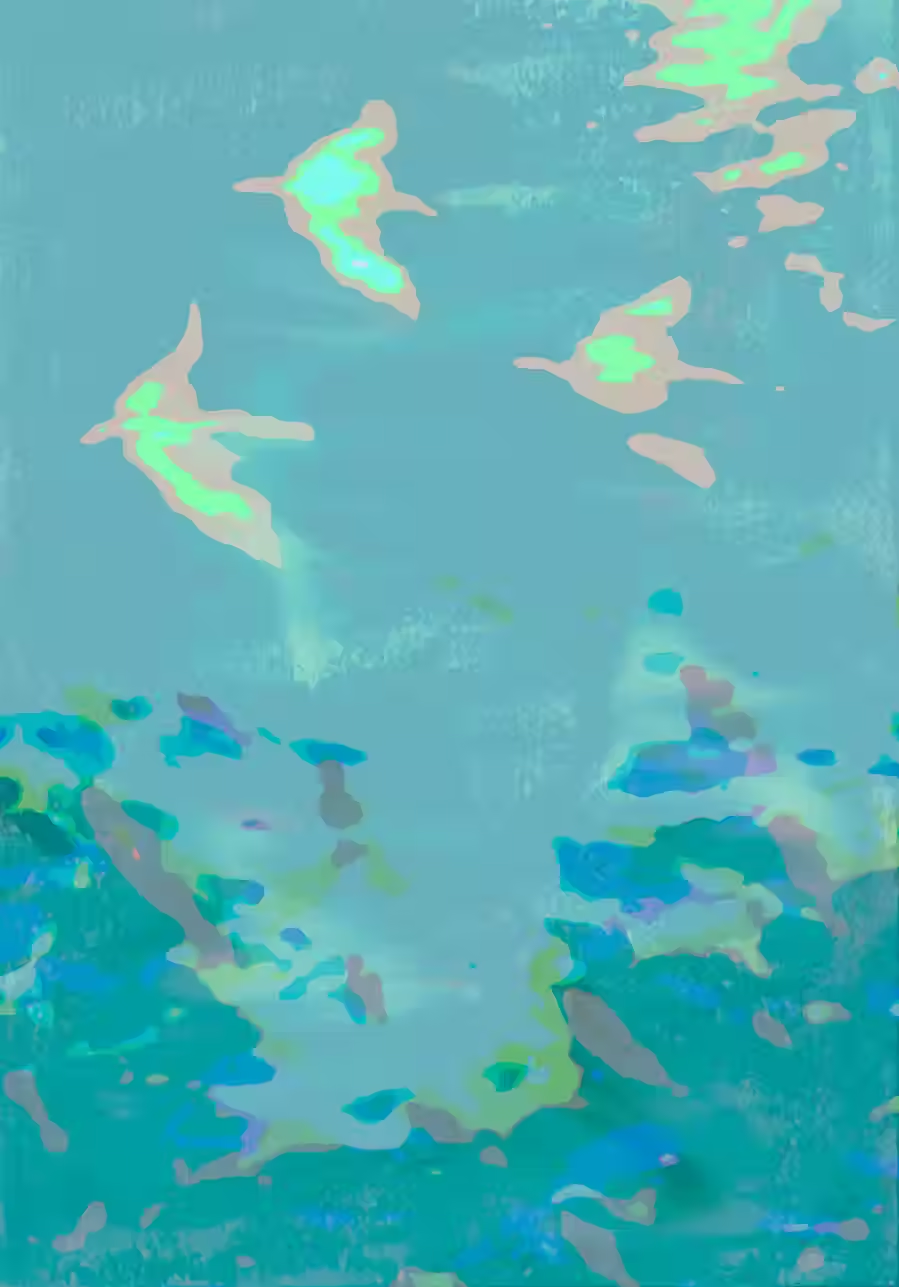


These images were initially created using pastels and coloured pencils before being digitally painted over and edited in Clip Studio Paint. I was particularly inspired by Dagou, whose use of coloured pencil creates a warm, hazy atmosphere. The soft, granular texture gently dissolves the edges of forms, giving the compositions a sense of tenderness and intimacy.
The series explores my relationship with isolation. I returned to the motif of the shower, depicting myself leaning against the wall and dissociating, contrasting this private stillness with moments of domesticity and life occurring elsewhere: a couple huddled together, the reflection of birds in the water, and flowers swaying in a field.
This work became an attempt to contrast my repetitive, self-isolating routines with the unnoticed inevitability of life and beauty carrying on around me.
Creating imagery that felt this soft and simple was a large jump from the darker and more unsettling themes I prefer to explore in my practice, but it was ultimately a refreshing change in direction.
This quick piece was inspired by the second Illustration Open Challenge's prompt, "A Beautiful Mistake". I felt the prompt was perfectly in line with Everyday Radical's ethos.
It illustrates the soft glow of a late afternoon, a relaxing moment between workers, a cat obliviously "ruining" their work, and kids in the distance riding their bicycles into the sunset. I wanted to recognise these easily dismissible transient moments. It practices something close to wu wei (無為), a central Daoist concept translating to "non-doing" or "effortless action". Instead of dramatizing a scene, meaning emerges through harmony with the universe's natural flow. The cat doesn’t intend to be radically resistant, it follows its nature (ziran). Yet the outcome subtly reshapes the environment, leaving unintended traces, the cat's pawprints that if gone unnoticed and uncorrected become small irreversible marks. Wet concrete is a moment between states, not yet permanent. The pawprints capture that in-between; accidental, ephemeral in intention, but permanent in consequence. Like the everyday, small, barely registered actions accumulate into lasting change. The radical gesture here is trace rather than revolution, almost the opposite of my Amplify project that focused on a very purposeful enactment fuelled by ideology. The workers chilling out reinforce this idea, labour paused as they enjoy their tea. Nothing is being “achieved” in a conventional sense, yet this is where the most meaningful mark occurs, not through productivity, but through interruption.
