AYU WHITMORE

LIVE BRIEF
ft. Leomi Sadler

Out of all the live brief options, Leomi Sadler’s stood out to me both for her passion for underground comics and the sheer scale of her collaborative work. Part of me choosing this brief came from a desire to strive for a similar shamelessness and confidence, the kind that enables meaningful discourse and engagement with other creatives, whether through collective participation or self-publishing.


Her briefing raised a number of questions. What does it mean to adopt an anti-aesthetic stance; when you reject the status quo, is that a kind of self-empowerment? Maximalism and the game of taste; Who decides what is tasteful? If normies like what I do, is that a red flag? Ultimately, where does meaningful validation come from?
Her discussion of anti-aesthetics resonated with an approach I have been wanting to pursue in my own practice - producing work that is more subversive, less concerned with the conventions of “art proper,” and willing to move beyond my comfort zone of realism and references.
Sadler’s work exemplifies this approach. I purchased a copy of her publication Tummy Bugs, a collection of comics that are both surreal and absurd, two qualities I hope to achieve within my own publication. “Normies”, as she put, sounds kind of crude, but I understand it. The validation I tend to value most often comes from artists and posters within more niche spaces. I am more of an observer than an active participant within creative communities, and through this project I aim to shift that position, moving from passive consumption towards active contribution within the visual cultures I engage with.
RESEARCH

Herzog notes a common device in imperial art was the representation of colonies as submissive women, and the presentation of indigenous women as prizes of conquest. Orientalist painters created a visual fantasy of the Middle East and North Africa where colonised women were depicted as exotic, passive, and available, framed as objects for the European viewer.
The same logic is prevalent in soft propaganda online. The harem scene is symbolic of a prosperity granting the conqueror access to both land and women. Out of all of the thing to discuss about the bombing of Iran, the discourse on my timeline was regarding the attractiveness of the Iranian women by Western males. From colonial postcards to memes, visual culture has repeatedly eroticised the figure of the “othered” woman.
When viewed through Herzog’s lens, these phenomena can be understood not as isolated features of internet culture, but as part of a broader historical pattern in which fascism reshapes desire and bodies to sustain itself.

I would best describe what I aim to encapsulate in my publication as a satire exploring the relationship between misogyny, racial ideology, and desire, examining how political power structures manifest through distorted online visual cultures. By mimicking the absurd and memetic imagery, I aim to critique the online right using its own visual language - from the fetishization of young anime girls as symbols of libertarian "freedom" to the dehumanisation of women within wartime propaganda.
Determining the subject of this book, a book that had been on my mind lately that I picked up at Magalleria was The New Fascist Body by Dagmar Herzog. It reveals how sexuality and reproduction are not peripheral to ideology, but central mechanisms through which power is normalised and reproduced.
Herzog analyses the visual language of the late nineteenth century Nazi media landscape through to the AfD (Alternative für Deutschland) party's propaganda campaigns. The eroticization of domination, articulated and legitimized as a preventive or pre-emptive self-defence, cannot but transit through sex (and, be it oppositionally, gender) considered as, in Foucault's The History of Sexuality, an "especially dense transfer point for relations of power" (Foucault, 1978, p. 103). In Herzog's words, "sexy racism" manifests as the "libidinally-charged messaging to mobilize fear, outrage, and aversion or, alternatively, to convey the thrill of dominance vis-à-vis various forms of radicalised vulnerability." (Toscano, p. 73).
This framework became relevant to me when considering the discourse I've witnessed increasingly online, where attraction and relationships are interpreted through the language of race, hierarchy, value, and demographic survival.
"Another way to note if its a Western Regime change Putsch attempt is the sexualized marketing strategy in the West." - @MojaveArtClub on X

Another publication I read, The Kawayoku Tales: Aestheticisation of Violence in Military, Gaming, Social Media Cultures and Other Stories, published on the Institute of Network Cultures, explores how cuteness, sexuality, and entertainment serve as tools of domestication.
The soft power of the world’s most funded army is evident in the female soldiers of Israeli Forces, who appear to replicate themselves to the unconscious extent of dissolving as individuals and instead becoming a standardised reiterated simulacra in endless videos. This phenomenon is documented not only by the IDF’s own TikTok account but by YouTube channels, where short videos showcase repetitive choreographed routines of female soldiers. Scholar Maria Pramaggiore described the YouTube skits of US military personnel dubbing and dancing to pop songs in a chapter of the edited volume The Aesthetics and Affects of Cuteness; “Sexual provocations resonate with official propaganda that justifies the US War on Terror through a starkly drawn dualism pitting a secular, enlightened and egalitarian West against a patriarchal Islam whose oppressed women are in desperate need of rescue.” (Tafeche, 2023)


Photo © Getty Images/S. Gallup.
Above the 1866 French Orientalist painting The Slave Market by Jean-Léon Gérôme depicts a naked, enslaved woman having her teeth examined by a prospective buyer. The painting was used to publicize the anti-immigration agenda of the AfD. At the top of the poster reads: “So that Europe doesn’t become Eurabia!”
Online, the "sexual marketplace" is the imagined arena where individuals are ranked according to desirability-based factors such as looks, race, age, status, and social capital. Market language is borrowed to describe dating and sex as if they were governed by competition and value, often justified through evolutionary psychology. These communities argue that while "woke" contemporary society claims to reject hierarchy, it has simply relocated into attraction and partner selection, where reproduction is framed in eugenic terms as a determinant of civilizational outcomes and long-term survival.
In relation to geopolitics, intimate relationships are treated as a microcosm of broader power structures; race, empire, dominance, and selection, which transforms desire into an explicitly political imperial language. This is often underpinned by racial anxiety, particularly narratives of “replacement,” alongside an obsession with lineage and masculinity.
A more recent development I've witnessed online is the emergence of AI-generated “brainrot” content that features surreal cuckolding scenarios with anthropomorphic fruit, cats, and anime-styled characters. Encoded are racialised narratives of reproduction, interracial babies visualised through species or colour. In this context, AI-generated imagery functions as a contemporary vehicle for ideological desire, embedding ideas of hierarchy and reproduction within absurd, algorithmically optimised forms.


AI-generation of desired women is prevalent in the online right's sphere, the video above an AI anime interpretation of one of Sydney Sweeney's interviews. Right-wingers were enthused about it as she refused to acknowledge or apologise for allegations of white supremacy after the "good genes" advert scandal. In this sense, AI is a tool for mass-production of propaganda using women as their poster-girls. These women are oftentimes fake, an example being "Amelia", who became the fictional poster-girl for the pro Reform/Restore UK.
Annoyingly I was unable to present around the time of the interim crit. My PowerPoint slides below remain as an example of the direction and ideas I was aiming to communicate.
I contacted my lecturer to see if I could reschedule an online discussion with Leomi, but she was occupied with her own projects at the time. I did however receive general feedback noting the importance in scaling back ambition where necessary and managing time realistically throughout the project.


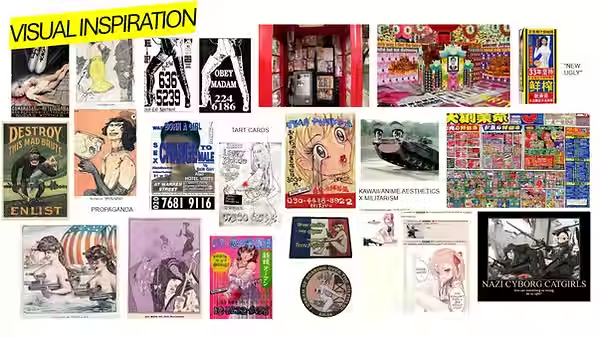
Visually I wanted the book to feel inspired by digital aesthetics. When in Hong Kong over the holidays I noticed Tart Cards advertising sex work. I found similar examples online, the crudeness of how they are drawn is something I aim to emulate. Online there is a prevalence of trashy pornographic advertisement that has even extended to AI, digitally sexualising.
Another thing I wanted to include was “brainrot” aesthetics, emulating low-quality AI content made to farm attention. They are surreal, absurd, and often disturbing, featuring characters (including hybrids like animals, objects, food) optimized for engagement.
Using this graphic language, I want to make propaganda visuals that are satirical, humorous, and disturbing.


I wanted to utilise text similarly to Jenny Holzer. Her “Truisms” series contains statements like: “Abuse of power comes as no surprise.” “Protect me from what I want.” A lot is shocking content like in her “Inflammatory Essays”, which mimic extremist propaganda language. I thought to do something similar with tweets I found relevant to my theme. Possible adaptation could be through creating pages with bold, reactionary rhetoric.
INTERIM CRIT
I felt these digital aesthetics meshed well with the New Ugly advertising and graphic design I encountered in Hong Kong. The maximalist compositions, abrasive colours, and cluttered layering all seemed designed to aggressively compete for attention, reflecting both algorithm-driven visual culture and the capitalist environments that produce it.
I was particularly interested in how this visual overload mirrors online spaces, where images constantly fight for visibility, engagement, and stimulation.


For the back cover, I used a sketch created in Microsoft Paint. I deliberately chose such a simple program because of its raw, pixelated aesthetic, which suited the project’s digital theme. I then applied a dithering effect to add a low-resolution quality to the image.


I lowered the opacity over a black background and added a yellow-green border, drawing inspiration from the aesthetics of New Ugly graphic design. I chose the bright green specifically because of its garish and visually abrasive quality, which suited the unsettling tone of the project.
For the front cover, I painted a headless woman reclining in a sheer dress. Initially, I did not have a particularly clear direction for the image, something reflected in the cliché nature of the headless female figure itself. Eventually through experimenting with digital editing and mirroring the composition, the image transformed into something far more cryptic and almost demonic in appearance, which ultimately felt more appropriate to the themes of the publication.


For the first page, I illustrated an archetypal “trad wife” holding a pie in her apron, contrasted with a rattlesnake wrapped around her neck. The snake references the imagery and values associated with the Gadsden flag, which is why I chose a dominant yellow palette throughout the composition.
On the first page I wanted to explore the contradictions within certain forms of right-wing femininity, where traditional domesticity becomes intertwined with individualist or reactionary political identity. The forum-style quote in the centre was written by me to imitate the tone and rhetoric commonly found within online conservative spaces. It reflects the mindset of women who frame their political beliefs not as self-preservation, but as empowerment and strength, despite often reinforcing systems that work against their own interests.
The crude, memetic soyjak-style pencil drawing was inspired by an online argument I came across in which men obsessively debated whether small or large breasts were “better.” The discussion became so steeped in pseudo-intellectual racial and biological rhetoric that the satirical text I wrote for the piece was not far removed from the tone of the original posts.
I depicted both figures as equally isolated and psychologically consumed by online ideology. One is surrounded by flags and symbols, entirely entrenched in reactionary identity politics, while the other appears as a stereotypical weeb hikikomori figure retreating into escapism and internet subculture. Rather than presenting one side as more rational than the other, the image portrays both characters as products of alienation, obsessive online discourse, and the increasingly distorted ways identity and desire are mediated through internet culture.


Within manosphere and adjacent online discourse, WMAF relationships often appear in contradictory ways. In some right-wing or incel spaces, they are criticised as evidence of white men betraying white women or as symbols of an imbalanced racial desirability hierarchy. In other factions, the same pairing is idealised as an “optimal” relationship, shaped by racialised beauty standards and even pseudo-eugenic ideas surrounding femininity, submission, status, and reproduction.
In this context, WMAF becomes less about genuine human relationships and more of a political and symbolic construct through which race, class, technology, and power are eroticised. The woman ceases to be viewed as an individual and instead becomes a status symbol or proof of ideological success. What interested me was the absurd contradiction at the centre of this rhetoric: a racist, white supremacist worldview simultaneously promoting and fetishising race mixing when it aligns with its own hierarchies of desirability and power.

Reactionary women
For my side zine, I wanted it to help contextualise the themes explored in my main book. It features sketches alongside black-and-white scans of tweets, memes, diagrams, and fragments of online imagery, creating something that feels closer to an archive than a traditional publication.
The zine was intended to reflect the overwhelming and fragmented nature of online spaces. By presenting these materials in a raw and collage-like format, I wanted the publication to feel immediate, chaotic, and reflective of the digital environments that informed the project’s themes.
FEEDBACK
Reflecting upon what was discussed in my feedback:
-
While I initially envisioned the audience to enjoy this book as people already versed and interested in reactionary internet culture, Leomi pointed out this is more of an educational (or rather, awakening) read for people who are oblivious to what is happening behind the scenes online, the same people who question why there is so much nastiness in the world without digging very deep.
-
Regarding the side zine, I should have photocopied it. I incorrectly assumed that wouldn't be necessary, but in a professional self-publishing scenario there is an obvious need to scan the book for there to be multiple publications. The graininess of the images produced by the sticker printer would be accentuated when enlarged on photocopier as well. I did however think the cover looked lazy, but Leomi thought the simpleness worked effectively. She thought it was clear in conveying its subject matter of sex, desire, racism, and misogyny.
-
The main publication's opener was effective in both grabbing Leomi's attention and setting the tone. She didn’t want to read out the message board text I put there, so I succeeded in creating a raw uncomfortableness.
-
Leomi said she was really excited to see an illustration student so engaged with the world that we’re in, especially visual culture, as it has completely transformed in the last couple of years, meme imagery being a hugely transformative power. As their potency lies in their ability to weaponize cynicism and irony, to criticise is to become "cringe", but in using “their” weapons against them it becomes the most effective way to criticise. I would go so far as to say why dirtbag left culture has seemingly made a resurgence rebranded as "dark woke", as a large amount of the power in its rhetoric comes from the humour. In this way, my publication did somewhat succeed in being critical of the far right ideology is ridicules.
-
Leomi said I was effectively selective in creating images that get to the heart of the issue I aim to convey rather than simply scratching the surface. We did have a misunderstanding at first where she didn't realise they were my visuals, believing I found and grabbed memes, editing, warping and collaging them together, rather than creating them organically. She said I replicated the meme imagery well, and that my image making was “really advanced”. At first I did feel as if this was a fault since I don’t have a consistent art style or workflow, resulting in drastically different images. Our tutor noted that the way I’m pulling stuff together, the things that I’m looking at and that are being represented- so much of that is me, it’s not that I need a “style”, my voice is my style. Leomi notes my style feels like a natural reflex, all the rotten material and visual language has come into me and I have expelled it successfully. She said that each page being so different is a good thing as they individually do so much, and that I’m good at saying things with my images (the highest praise to receive as a visual communicator!).
-
Leomi noted that now we’ve seen how nasty this culture is, I should better consider where I position myself amongst it. The audience has been shocked, but what next? Dan Mitchell, publisher of Hard magazine was mentioned, as his work utilises large chunky text in images not dissimilar to what I attempted. He processes the nasty material in a nuanced way. There is potential for me to take the reader on more of a journey this way, but I must consider first what the story I want to tell is. Do I want to show who the victims are, or the "perpetrators"? What is the interesting part for me - how the "perpetrators" get to this point, the material conditions leading to it? Or is it more about me sharing my personal experience and how it’s affected me, and will I take an explicitly political position in response, or remain ambiguously neutral, spectating? The challenge to having access to this incredibly broad and awful material is the fact that I can easily show it, but it is hard to create parts that really surprise the audience, perhaps in revealing our own biases or buried discomforts.


© Dan Mitchell
On a more light hearted note, Leomi reminded me I’ve got to be funny with it as well. Especially when using memes, a book taking the perspective of a cynical “femcel” (Leomi said it not me) would be an effective way in conveying the absurdity of this culture. Again, the humour is what makes it dangerous. She also reminded me I needed to manage my diet of consuming negative and positive things, being immune to the toxicity is not necessarily a good thing, and I should give myself non-political, "less doomy" stuff for nourishment. It’s all about balance!
Overall, I'm happy Leomi approved of my publication's direction and execution, and will definitely explore self-publication and book-making more in the future. I see now how powerful of a medium it is and would like to further improve my storytelling and conceptualisation skills. Like Dan Mitchell I'd like my work to capture more of a raw and uncomfortable feel, really pushing into rejecting clean modernist minimalism in favour of visual excess, clutter, irony, and anti-aesthetics.
