
TELLING STORIES



Photograph © Vogue Germany, Sebastian Kim. Featuring Magdalena Langrova.
Minimalism isn't the only trademark of designer branding-- haute couture has turned destitiution aesthetic, swaddling models in material madness. Slavik, a homeless man from Lviv, Ukraine, became a street fashion icon who's sartorially innovative approach of layering scavenged clothes paved the way for streetwear. Thrifted pieces were appropriated by Balenciaga, selling the style for thousands. Vogue Germany's editorial entitled 'Signs of the Time' features a similar eclectic amalgamation of designer brands paradoxically representative of economic failure. Slavik recieved no credit for inspiring the "haute homeless" aesthetic that is essentially a repackaging of poverty for the elite-- what was born from marginalised necessity became a fashionable pose. Just as Rothko's minimalist canvases can only be accessed by people with cultural capital, haute homelessness is meaningful only to those who can afford to cosplay poverty.
This workshop emphasised the importance of what visual design can indicate. The imagery I create and utilise doesn't exist in a vacuum, anything I create is a cultural product operating within systems of ideology and value. In the context of packaging design, the tiniest details can distinguish one as gauche from exclusive, and an inherent classism governs who decides what is considered such.
WORKSHOP 1
Smelling Stories
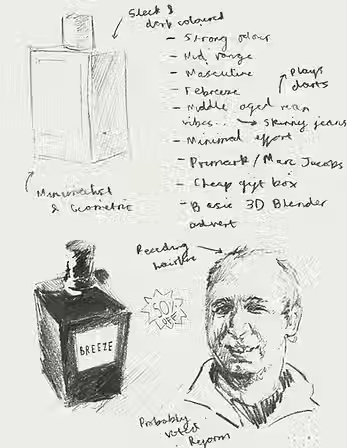
Our first workshop tasked us to design the packaging/bottle of an unlabelled perfume and envision a character likely to use it, an approach that encouraged us to consider characterisation from an entirely different lens, or rather sense, that being smell.
Packaging allows us to distinguish high and low end products as branding supersedes quality in importance, commodities are detatched from labour and material sourcing. Think Tiffany & Co.'s signature blue box-- consumers see luxury incarnate and commodities are reduced to status symbols, boxes that have no utility beyond aesthetics add perceived value that helps justify extortionate prices. Stripping the product of the casing had us design something based purely off its original function without bias.
Our group's general consensus was that our vial smelt vile, having an unpleasantly artificial chemical quality to it. Our character is a standard middle-aged bloke putting in minimal effort for a date, spritzing the first cheap eau de toilette he spotted in the clearance aisle while checking out in Primark. It is unassuming and aggressively plain to appeal to the traditional macho-posturing men who are affronted by bright and "effeminate" colours on their purely practical cosmetics.
We were unperturbed to discover the mystery perfume was Byredo Blanche, a popular fragrance priced at £150 for 50ml. Statistically it was unlikely all of us were nose-blind, the reveal reinforced Marx's theory of commodity fetishism-- the mythical value ascribed was the sensation of aspirational exclusivity in possessing a designer label. The scent itself wasn't anything particularly special, the branding dictated its worth. What we all concluded was cheap was high-end, without the visual presentation we compared it to that of Febreeze. I even came across a website featuring perfume dupes that featured a knock-off of Byredo Gypsy Water, stating "The bottles look similar too, so you could even pass it off as the real thing while it sits on your dressing table."
It echoes criticisms of contemporary art, abstract pieces indistinguishible from a child's scribbles being auctioned for millions under influential names. Some explicitly exploit this embroilment in their work-- Maurizio Cattelan's infamous Comedian (2019) triggered waves of art discourse, a banana duct-taped to a wall selling for $120,000 (≈£90,900). Baudrillard's sign value, economic counterpart to the dichotomy of Marx's exchange-value vs. use-value, is proven here: in a consumer-oriented society, value is not intrinsic but symbolic, derived from cultural capital. Simplicity becomes a mark of sophistication, the banana visually minimal like Byredo packaging.

Photograph © Rhona Wise/EPA, Maurizio Cattelan’s Comedian.

© Lionsgate Television. (Mad Men).
This isn't to say contemporary art is simply a vehicle for capital the way name-brand products are-- creatives like Rothko revolutionised art by rejecting literal representation, rejecting earlier forms of art that functioned as a symbol of status, relying on patronage from elitist institutions. Abstract expressionism has the same approach as branding, minimalistic designs that focus on creating a shared emotional experience, ritualistic. Comedian challenges the viewer as a consumer, art reflecting the market transcends mere fetishism, the absurdity of the banana parodies its very condition of art-as-commodity. Whether or not this simplification of visual language has become a new form of aesthetic elitism-- only to be appreciated by the educated-- remains highly contested.
Moving forward I will consider the social implications of every image, what my storytelling adopts or critiques, and whether the narrative seduces the audience or exposes that seduction. The audience is not passive, I should consider how I want the reader to consume this story, as well as what that consumption says about them, or about culture.
Following the same 'less is more' logic of brand packaging, and abstraction Rothko employed to inspire a transcendental emotional response, I aim to figure out how best to convey a narrative without literal representation.
To establish my direction I dissected some of my favourite critically acclaimed entertainment (A Clockwork Orange (1971) and Succession (2018), identifying the common denominators and convergences in narrative (philosophical foundations & thematic meaning) and analysing visuals.
Satire & Anti-heroes in Art
Stanley Kubrick's magnum opus A Clockwork Orange (1971), adaptation of Anthony Burgess' 1962 dystopian novel, explores the tension between free will and social conditioning through state reforms: when the ability to choose wrongdoing is psychologically removed, can a person be truly good without the freedom to be evil? The Ludovico Technique, a fictional aversion therapy the anti-hero Alex undergoes, parallels B.F. Skinner’s operant conditioning, a learning process that controls behaviour through consequences. Burgess presents this logic as flawed and dehumanising throughout the narrative, it parallels Kantian ethics-- moral worth can only be determined through free thought, the conditioning reduces man to machine, “When a man cannot choose, he ceases to be a man.” Utalitarianism may bring about happiness for the most; but strips one of autonomy and justifies authoritarian control, behaviorism may reflexively socially-condition a person into morality; but coerced goodness is meaningless, especially to Burgess who was Roman Catholic, and who's moral framework was based on repentance, sin and choosing between good and evil.
Literary analysis

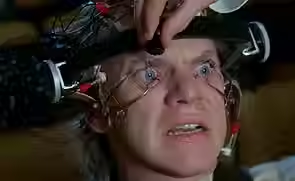


After Alex jumped from a window to escape his state of inability to act on his impulses, his treatment is undone to avoid political scandal, leaving him to exclaim "I was cured alright!" Alex has been cured of the cure, a happy ending, as while his impulses have returned he agrees to not act upon them, albeit incentivised through bribery, becoming the successful hypocrite of society the government (that was more concerned about making crime rates appear reduced than actually preventing it) wanted.
Thematically, it's the search for meaning from Alex after becoming a moral automaton that interests me, Burgess' clear opposition to state-enforced reformation brings to question Alex's purpose after being stripped of free-will. Alex and the state are presented as as bad as each other, both seeking control, albeit one through instinct and the other through system. The lack of a cohesive style throughout reflects Alex's arc, beginning with wide angled lenses, dolly shots, and garish pop and baroque futuristic design; creating a sense of unreal, and Kubrick's mise-en-scène aestheticising violence into absurdity while classical music played, juxtaposing the barbarity. Alex's time in prison is far more muted, desaturated colours and slow camera movements reflective of his mind, subdued. Yet there is consistency in the setting being a bleak dystopian futurescape both in and outside of prison, and while I'm not normally a fan of sci-fi, the avant-garde mix of brutalist architecture and kitsch, classical music and synthesisers, and provocative fashion make for a far more interesting setting than the cliché totalitarian state USSR knock-off who's individualist hero escapes "the matrix". Instead we're confronted with a protagonist who is refreshingly irredemeable in a static system.
A similar irony and existentialism is employed in Jesse Armstrong's drama-comedy Succession (2018), particularly within protagonist and anti-hero Kendall Roy. The entirety of the show follows the power struggle between the Roy siblings fighting for CEO position of the family media conglomerate, at the mercy of the patriarch, their father (only for it to be (spoiler alert) taken by a "clumsy interloper" in-law, ending its short-lived legacy as a family enterprise). Parodying the media industry, while A Clockwork Orange critiques authoritarian governing, Succession ridiculues capitalism through Kendall's performative PR progressivism, the narcissism of nepo-babies (one of whom ran for president, while having no conventional job experience), and sycophantic jesters like cousin "Hey... big fan... of all your money" Greg. Unlike Alex, Kendall is happy to perform, banking all his meaning in succeeding the company; "I am like a cog built to fit only one machine."
Kendall's autonomy is fantastical, pendulum swinging between vying for Logan's approval and staging petty attempts at takeovers. It is satirical genius, Shakespearean stakes of legacy and succession undercut with deadpan realist corporate jargon, a mockery of the American dream and the myth of meritocracy. As comedian Demi Adejuyigbe put in his viral remix of the theme song, “All the rich white folk are going to argue, and then whoever’s best is going to win a kiss from daddy”.


My favourite types of characters are the most irredemable ones, and if Succession excels at anything, its at having a truly despisable cast: all smarmy, servile, and voraciously self-interested. At its centre stands a patriarch who despises his children precisely for inheriting the privilege he created, a man whose contempt becomes the founding logic of a dynasty. The result is a brood of narcissists, each a unique reflection of their father’s pathology. Kendall is both addict and hypocrite, a man who conceals a vehicular manslaughter while preaching moral clarity and condemning his father, an embodiment of Nietzsche’s resentiment: the slave-moralist who condemns in others what he cannot purge in himself. Roman’s crude machismo masks a deep erotic confusion, his masochistic attachment to authority enacting Freud’s repetition compulsion in a corporate frame. Familial interlopers Tom and Greg remain stuck in a homoerotic push-and-pull of blackmail and devotion, dramatising the Hegelian master-slave dialectic as farce, domination giving way to dependence. Like Alex in A Clockwork Orange they are all subjects of late-capitalist conditioning, creatures who in their very depravity reveal how thoroughly choice has been scripted. Their cruelty and vanity are not rebellion but the most human gestures left within a mechanized moral order.
"I am the eldest boy!" Kendall cries, a pathetic last ditch attempt, less an argument than an echo of a child begging for recognition. Though he ends nominally free, untethered from the company and his father’s shadow, his freedom feels less like liberation than exile. Even with limitless wealth, it remains doubtful he will find happiness in a life beyond the architecture of power that formed him. Even the “clumsy interloper” who inherits the empire is condemned to his victory, a hollow triumph, condemned to the sterile logic of capital. There is no redemption, no catharsis, the system persists with indifference-- money never sleeps.
Narratology

Our Narratology workshop underscored the value of deconstructing stories to reuse their elements. It is crucial to distinguish homage from imitation when borrowing from other media. Wes Anderson’s distinctive style (whimsical aesthetics, symmetry, precise composition, and a singular colour palette) ensures that even when he draws from classic cinema, the material is refracted through his unique vision. His Torn Curtain inspired sequences in Grand Budapest Hotel exemplify this transformation. Anderson bridges classical thriller aesthetics with his own stylised modernity. For those familiar with both films, the reference operates as a witty acknowledgment of influence becomes an inside-nod, for others, it remains a strong self-contained scene. This duality defines successful homage. It enriches the work without relying on recognition.

This intertextuality is crucial to creating a story informed by works of the greats. David Lean recontextualizes Ford’s imagery from the American frontier to the imperial/colonial frontier in Lawrence of Arabia. (Finish writing)


We were tasked to capture a defining scene in one of our favourite films in just three shots. I chose a scene from black comedy film Four Lions (2010). Cinematography wise, it purposefully switches between our main characters to their friend Brother Faisal blowing himself up by accident. The switching back and forth shows our characters' (who were previously joking around) now horrified expressions. No words are exchanged, the silence speaks for itself, and the result is hilarious. It touches upon the technique frame within a frame, the fence they're peeking through emphasising how far they are and Hassan, the character furthest away, not yet clocking onto what has happened, still stupidly smiling.
I thought this sequence a good example to play with the Kuleshov effect, considering how easy it would be to change the feel by just altering the middle frame.
Put scans here uhuuhuuhhh

To end off the workshop we were told to draw a 3 page comic in just a couple minutes. With not much time to think about the concept I settled on a, at first glance, cute story between old-lady and her pet cat that quickly takes a cannibalistic turn. I'm used to thoroughly planning pieces before executing them, even if they are intended as a simplistic satirical cartoon, so this was a challenge, and the perfectionist in me dislikes the drawings thoroughly, but for something done in such a short time I'm satisfied. Being that afterwards when we took a look at eachother's comics and mine was highlighted as morbidly surprising and humorous, I'd say I achieved what I set out for, and the reaction I got from such a simple strip is what matters.
Guest Lecture
We watched a pre-recorded guest lecture by illustrator Lesley Imgart. She challenged us with a storytelling exercise, making a four-panel comic using both text and image to notice what’s been on our minds and communicate it through art.
Three metaphoricap prompts were given to assist us and narrow things down.
- What am I afraid of?
- I feel that something is changing.
- A reminder to myself:
We should resist the urge to draw exactly what the text says, and
not think too much about whether the writing or drawing is good. What matters is that ours.

Initially, I thought to illustrate the idiom 'shooting yourself in the foot', and included captioning reflective of a self-sabotaging mentality, "I'll ruin my future for a temporary feeling", and the ironic "am I paranoid enough?" The issue is it both shows and tells, and so with prompting from out tutor I changed the words to be seemingly unrelated, showing the process of a person snozing their alarm. This shows how self-destructive behaviour can manifest in simple acts of laziness.
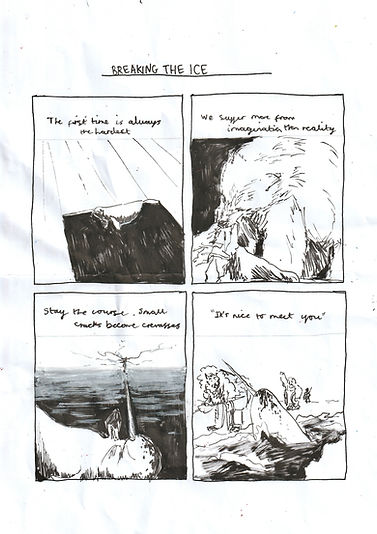


I was inspired by Succession to create a similar anti-capitalist narrative from the random prompts given.

Our thought experiment of the day was to create a character based on a randomly assigned object from one of our lecturers vast assortment of tchotchkes.
We had been given a wrought iron key.
Proposal- Control
***Finish writing this*** please I beg
The Medium is the Massage is "the first interactive/interconnected book of the information age." This was before the term interactive carried the electronic or computerized implications that it does today.
I'm applying this logic while deciding how to tell my story, the format or technology delivering a message that may have a greater impact than the content itself.

I decided I wanted to create an image that conveys the volatility of Indonesia's political climate at present. The theme I'm choosing is CONTROL. Westerners have been typically ignorant to the huge protests that occured this year and had multiple cities in flames. Mainstream media rarely covers corruption in the global South that isn't a Western-backed proxy war.
Posters of propaganda art caught my eye. They convey stories and ideologies satirically, without the literal intricacies and mundanity of politics.

As I've done research on OSPAAAL in the past I was reminded of Rostgaard's folding poster of Nixon. I decided to remake this with Indonesia's infamous President Prabowo.


Contemporary propaganda & caricature examples
André Carrilho
Discuss discourse around this image --> How even simple/cute seemingly innocuous works carry loaded ideological meaning/trivialise bigger issues. In relation to audience-- not being insensitive

Alter-ego (to do)
市川慧󠄁 KEI ICHIKAWA@KEI_ICHI2020
Needy streamer overload
Mask Girl
Vtuber culture (Rushia)
Boxxy/Creepy chan
-- Pengkhianatan G30S/PKI (propaganda movie of the New Order of the Indonesian military dictator Soeharto whose rule was established in the aftermath of the mass killings.)
-- The Act of Killing (Filmmakers expose the horrifying mass executions of accused communists in Indonesia and those who are celebrated in their country for perpetrating the crime.)
-- Revolusi (book)


I have changed my mind, rather than creating one propoganda styled illustration, I'd like to create a short video that tells the story while leaving out the intricacies of the politics. This introduces people who have no idea of Indonesia's political climate the complexities through a relationship, more accessible than an image with references that will only be understood by Indonesians. Being that I'm English and want to tell a story to other English speakers.
Indonesian elements. Perhaps told in wayang shadow puppet style. Komodo dragon or Geruda utilised-- iconic creatures recognised even ouutside of South east Asia.
Plot
KAMASAN & JAVANESE ART

My family's Javanese wayang artifacts from Madiun (East Java)
Risoprinting
.avif)

