AYU WHITMORE
AUDIOVISUAL
Adam Curtis is often called an artist despite creating documentaries, a genre traditionally oriented toward exposition rather than the avant-garde. Sequences such as the one excerpted from HyperNormalisation demonstrate how his practice transcends informational filmmaking. The visuals of palimpsest urban environments and panelki with late nineties music creates nostalgia for a time and place many viewers have never directly experienced. These cityscapes evoke a distinctly hauntological feel, the Soviet past persistently lingers, manifesting as a spectral presence within decaying architecture, eerily familiar yet disquieting landscapes. These “absent-presences,” reveal foreclosed futures, the palimpsestic layering of time echoing what once was and what might have been.

Video © British Broadcasting Corporation. (HyperNormalisation, 2016).
The backtrack used is Yanka Dyagileva's My Sorrow Is Luminous (Янка - Печаль моя светла) a song with stark lyricism, subversive of the ornamental, melancholic music that romanticises suffering through poetic abstraction. Dyagileva's bluntness gives the song greater emotional depth. To quote an anonymous commentor on YouTube, "I like how this song cuts all the bullshit and comes straight to the point. This is depression. It’s not beautiful or complex. Just sad."
I wanted to emulate a similar vibe to Curtis's documentary sequence but illustrated, and came across the animation 2012 (2018) by Ingo Raschka. Frames were first drawn on paper using a pencil, then scanned in to delete the white background in Photoshop, before being printed onto its own separate cel. Its a lengthy process to do for each and every one of the frames, but creates a distinctly hand-drawn feel.
There is an atmosphere of inauthenticity, befitting of the plot wherein two would-be lovers meet for an online date against the backdrop of the looming 2012 apocalypse hoax; “they never really communicate – they’re on different planets the entire time”. This sustained disconnect is central to what I aim to explore in my own work, the condition of estrangement from lived reality experienced by individuals who are already so deeply enmeshed in digital networks.

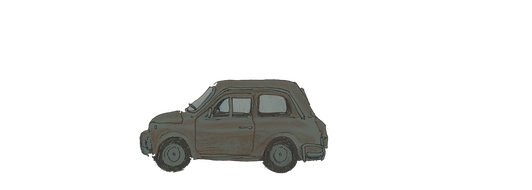
I aimed to create an infinitely scrolling background that would loop seamlessly along with the walk cycle. I chose to draw an urban environment similar to the videos above, a place of temporal disjointedness. A distinct absent-presence is felt by the empty bus stop, lack of people, and lack of movement.
All parts were drawn seperately so I could group foreground and background elements, and I used blending modes in Clip Studio Paint to unify the colours. Originally I intended to move the pieces at different speeds to create the illusion of depth, but I couldn't figure out how while preserving the loop. The green tint I overlayed was inspired by 2012 (2018), and gives the environment a derelict but calm feel.


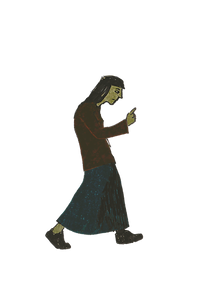


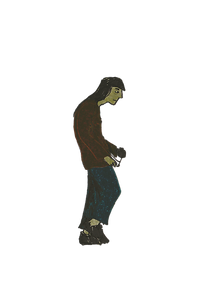


Each frame was hand-drawn in fineliner, scanned, and then refined in CSP, with the backgrounds removed afterwards. Rather than using flat digital fills, colour was applied through scanned crayon textures, preserving a tactile, hand-drawn quality and creating a pleasing grainy texture. Although effective, the process was extremely time-intensive, and not one I would realistically use for a longer sequence.
I refined the frames to give the figure a slight stoop, which I think adds a certain charm and better conveys the inattentive persona I was aiming for. The posture suggests a disengagement from the immediate environment, placing the figure in a kind of liminal state. This is reinforced through the downward gaze, wired headphones, and the phone held in the left hand. In retrospect, I wish I had pushed these gestures further by removing some of the energy from their step and softening the gait even more.
Having no prior experience with producing, playing instruments, or reading sheet music, I mashed up sounds from various experimental websites, Typatone in particular. It made creating mixes simple and accessible for someone with no experience, and I polished them into unique pieces in After Effects by keyframing audio properties.
My first attempt reminded a peer of the soundtrack of No Man's Sky, particularly Blueprint for a Slow Machine by 65daysofstatic, and our lecturer said the visuals paired with the audio created an indie, coming-of-age movie feel. I can see the resemblance to films such as The Florida Project (2017) or Mid90s (2018). The light, airy dinging has a dreamlike quality that brings a still tranquility to the scene.
The second outcome is my favourite. I took inspiration from Sea Power's Instrument of Surrender from the Disco Elysium soundtrack, a composition that plays in an environment scarred by failed revolution and the encroachment of foreign capitalist forces. The resulting dilapitated post-industrial urban landscape is not unlike the one I illustrated. The use of a cornet creates an iconic siren sound, and I tried mimicking this effect through ambient ringing. I also used textural sound effects, rustling and crunching that lends the setting a faint sense of life, presence within apparent abandonment.
In this iteration, I adopted a markedly different approach to alter the emotional register of the animation. A constant buzzing drone and intermittent dinging produces an ominous undertone that tranforms visuals that previously seemed calm into something sinister. It feels suitable for the atmosphere of a psychological horror game like the Silent Hill franchise.



I thoroughly enjoyed creating music in this abstract and iterative way, despite having little prior knowledge of the subject. Somehow, it complements the simple animation effectively, and I definitely intend to return to this approach to making moving image and sound.
WORKSHOP 2
Our audiovisual workshop led by Kristian Jones had us looking into various contemporary audiovisual performers and composers. I've enjoyed the work of Aphex Twin and Björk and looked into how live visuals functioned alongise their experimental sound.
Working in groups of four, we were tasked to create eight thirty-second audiovisual pieces. The workload for a single session was quite intense, so I took responsibility for the video compositing, having prior experience with After Effects.
The visuals were to be designed for live performance, controlled via a MIDI setup and synchronised to randomly assigned music.


Björk’s Cornucopia at The Shed, New York City. Photography Santiago Felipe. Stage visuals Tobias Gremmler.
Bjork’s audiovisual aesthetic is best described as a form of biophilic avant-pop, in which nature, mythology, and experimental technology are interwoven. Her work is strongly shaped by her Icelandic upbringing, the local landscapes and folklore permeating both her visual and sonic language.
I first discovered her through "Big Time Sensuality" from her debut album, though the visuals I analysed were from her most recent tour, Cornucopia (2023).
Björk’s live visuals are constructed like theatre work with voice and ensemble central and high-concept costuming that draws upon Comme des Garçons' anti-natural, sculptural silhouettes. One of the signature tricks is the many moving curtains that catch projections on various materials/textures. The layering produces depth and parallax like a forest of semi-permeable membranes, adding to the organic and futurist mycelial qualities of the stage design.
Projected are creatures, plants, spores, and organs, speculative landscapes built in standard 3D software and animated through algorithmic processes. Motion is made through simulated growth, and morphing cellular patterns with fluid-like dynamics.
Aphex Twin's live shows have an almost inverse philosophy. Rather than theatrical immersion, there is sensory assault - like a rave in which the visuals behave like corrupted software, and are largely detached to the performer.
His contemporary aesthetics is closely associated with Weirdcore, characterised by overexposure, typography, abrupt cuts, and seizure inducing intensity. It's anti-theatrical theatre, the stage persona is deliberately distant; the visuals often do the frontman role. It compliments the music which resists conventional pop structures. Drops aren't resolved, melodies refuses clean climaxes. The drama is anti-teleological by denying payoff.
Björk and Aphex Twin have shared cultural proximity since the UK electronic scene of the 1990s, most notably with critics identifying Aphex’s rhythmic influence during Björk’s Homogenic era, but their visual aesthetics clearly differ. In Aphex Twin’s performances, the visuals themselves become the primary performer, engulfing the audience in visceral stimulation, whereas Björk’s work foregrounds theatrical communion.
I took inspiration from Aphex Twin's visual-first electronic approach while incorporating elements of Björk’s avant-garde aesthetic in the shots that follow. Combining the two had the potential to merge fluid, organic motion with moments of intense sensory overload that compliment the track's crescendos and dissolutions.


Screenshots from Aphex Twin Live at Field Day 2017


The track our group was given to perform was Let Not (Your Heart Be Troubled) by Lady Blackbird, a title that references Jesus's farewell in the Gospel of John (John 14:1, 27). While falling under jazz, soul, and contemporary gospel, genres I don't usually listen to, the song's emotive vocals really grew on me.
I didn't have the time to create 3D visuals in Blender in Bjork's style, instead manipulatig lighting in old footage I recorded to create fluid movements of colour, reminiscent of her signature biological feel. Aphex Twin's influence appears through the iterative use of generated overlays, producing cryptic and hypnotising visuals.
I think the final outcomes suit the song well. Layered footage filmed while drifting through Nottingham’s busy streets creates a communal presence, aligning with Christian notions of collectivism. Multiple animations were done by other group members (I'm grateful to have had such a reliable and trusting team). I integrated them with visuals generated in p5.js and Hydra, overlayed using blending modes.
This workshop introduced me to a whole new approach to illustration and moving image, solidifying my decision to pursue an audio visual outcome rather than a book for the module's final piece. By merging analogue with technical systems, the online and cyber themes of my work can be better reflected.
NARRATIVE
“Anytime you conclude that life stinks and the human race mostly amounts to a pile of shit, you’ve got the perfect breeding ground for fascism.”
– Lester Bangs
For my audiovisual piece, I am developing an animated narrative that combines my earlier frame-by-frame animation work with the more abstract and generative visuals inspired by Aphex Twin’s live performances. To help inform the narrative, I researched individuals whose identities and ideologies were shaped by difficult material conditions and their immersion in online culture.

Fan collage of Harris & Klebold. Lyrics from "The Kids Aren't Alright" (1999) by The Offspring (jumbie-ist-meine-liebe, Tumblr, May 2015)


Screenshots © Professor Bright Films. (Zero Day, 2002).
Ben Coccio's Zero Day (2003) engages with the 1999 Columbine High School massacre, an event linked to over seventy copycat cases worldwide, many involving perpetrators who were influenced through the internet. Zero Day adopts a found-footage, amateur-video style framed as homemade video recordings made by two suburban teenagers, referencing the unreleased Columbine "Basement Tapes". Coccio offers a speculative substitute: shaky framing, blown-out highlights, poor audio, and awkward zooms.
While public discourse around Columbine focused on bullying, gun control, mental health, and videogames, the internet's role was often overlooked. Online spaces like Tumblr fostered fandoms such as the True Crime Community (TCC) who idolised these individuals, especially active in the early to mid 2010s and still present to this day. Fan-created edits and texts frequently reconceptualized the shooters as victims, allowing users, who often experienced alienation themselves, to identify with them.
Joshua Citarella, an artist whose recent work focuses on internet studies, argues that attraction to online extremist ideologies stems less from ideological conviction than from broader cultural and structural failures. He frames radicalisation as symptomatic of contemporary conditions rather than individual pathology. Drawing on ideas aligned with hauntology and post-capitalist critique, Citarella suggests that when the future feels foreclosed (ecologically, economically, or socially) extremism offers a distorted sense of agency. As he notes, “So long as these core material issues remain unaddressed, the online radicalisation problem will continue to get worse… There is no technical solution to a political problem.” (Citarella, 2024) Accordingly, I aim not only to critique and satirise these online spaces, but the systems that enable and sustain them.
Many other shooters have been similarly glorified online, notably Elliot Rodger who carried out the 2014 Isla Vista killings. Within incel communities on forums such as PUAHate and 4chan, he was venerated as the “Supreme Gentleman,” May 23rd designated “St. Elliot’s Day.” This symbolic elevation influenced later attackers, including Alek Minassian who referenced "retribution" and "Incel Rebellion" prior to his 2018 attack.
More recent cases reflect an increasingly incoherent and memetic form of radicalisation. In January 2025, 17-year-old Solomon Henderson opened fire at Antioch High School. His manifesto largely consisted of plagarised material drawn from earlier attackers' manifestos (notably Brenton Tarrant). Henderson was also connected to Samantha Rupnow, both linked to the decentralized accelerationist network 764, an online group recognised by the ADL.

Meme courtsey of @G36_Ak5 on X
Visually, I want to take inspiration from the absurd aesthetics of fan-made edits, early 4chan interface, esoteric iconography, and moe anime memetics. By deliberately adopting the visual language through which extremist ideas are circulated, I aim to critique the memetic glorification from within its own aesthetic framework.
For the plot of my animation, I aim to convey a radical pipeline.
When younger I felt displaced and grew up extremely online, resulting in the internet becoming central to my identity. I found belonging in digital communities of similarly othered people. My audiovisual aims to emerge from my awareness of how easily that search for belonging leads people to extremist pipelines in algorithm-driven echo chambers. The protagonist will embody struggles I have both observed and experienced: moral scrutiny, sexual double standards, and ideological seduction.

Fanmade edit of footage from the videogame Morimiya Middle School Shooting (2018) by @pervertcel on TikTok (video since taken down)
Even across the globe in Indonesia, 17-year-old Fadel Nazriel carried out a bombing at a mosque, injuring dozens. Despite not being white, he referenced Nazi slogans and figures associated with white-supremacy. In all these cases, extremism functions less as a structured belief system than an assemblage of grievance, irony, and mythmaking drawn from subculture. This mechanism appears in edits and fan art or fiction, as demonstrated by the TikTok shown. A cover of the song "Nyaatural Selection" plays over footage from the game Morimiya Middle School Shooting, the title an ode to Eric Harris' "Natural Selection" shirt.
NARRATIVE (CONT.)

"Don't forget: you're here forever" reflects 4chan's bleak, self-aware culture: the idea that users cannot escape the conditioning of the site's toxicity and isolation. The phrase carries a mix of irony, nihilism, and comfort — suggesting that while the internet, politics, and people change, the anonymous cycle of posting, doomscrolling, and online escapism remains constant.
Victoria Vincent, known as Vewn online, is an animator who's work has become increasingly critical of neoliberal society and internet culture by mimicking its fragmented, overstimulating visual language while exposing the emotional emptiness underneath it.
Her recent work Snooze Quest follows a character haunted by the victim of a murder they witnessed while searching for sleeping medication. In my own audio visual work, I aim to capture a similar aesthetic through the layering of memes, low-resolution graphics, advertisements, ironic humour, and abrupt tonal shifts.
I'm a casual listener of the Horseshoe Theory podcast hosted by YouTubers Greg Guevara (JREG) and Brogan Woodman (Artchad). I've followed JREG's work for quite a while, ever since his iconic Political Compass rap videos that initially propelled his online popularity. I first encountered them as an impressionable teenager whose ideological affiliations were easily influenced by aesthetics - precisely the tendency those videos were parodying. His satirical work strongly relates to my topic, often exploring obscure internet-based political identities such as NazBols, ancaps, and MAGA communists; ideologies that are typically only performed through anonymous online spaces. They featured Vewn on the podcast, though the discussion itself contained surprisingly little direct analysis of her work. Instead, the conversation carried an aloof tone characteristic of the kind of humour her animations embody. Much of the episode revolved around sardonic conversations about topics such as suicide rates by profession, the idea that many straight men are “spiritually gay,” and joking proposals for “universal basic Xanax.” While the episode was admittedly more edgy and less educational than, for example, their interviews with Joshua Citarella, it still provided useful insight into how Vewn integrates dark humour and detached irony into her surreal animations while still maintaining a sense of seriousness and, at times, tragedy - which is exactly what I aim to achieve in my own work.
I have to remain tonally sensitive and avoid becoming outright offensive, despite approaching the subject through satire. The animation is aimed at teenagers and young adults, who are often the most susceptible to online radicalisation, with the intention of both exposing the absurdities of these spaces and creating something they may find relatable.
SYNTHETIC FEMININITY / AI PSYCHOSIS / CHRISTIAN TRANSHUMANISM

Meme courtsey of Final Girl Digital on Substack
As such, I decided on a protagonist modelled on the concept of the “Young-Girl” — a figure in cultural theory representing commodified femininity. She is an ex-sex worker turned Christian influencer whose sincerity remains intentionally ambiguous, appearing either genuinely faithful or subtly performative.
As she becomes increasingly ridiculed and dehumanised online because of her past, she begins to lose faith and is eventually drawn toward an AI that appears to “understand” her in a way other people do not.
As part of the fantastical narrative, I wanted her to undergo a form of “AI psychosis,” inspired by increasingly surreal real-world cases of people relying on AI for emotional or spiritual guidance. One example I encountered was a megachurch generating an AI version of the deceased Charlie Kirk to speak posthumously, something many Christians and atheists alike described as demonic.
This also connects to Christian transhumanism — a movement combining Christian belief with the use of technology to enhance humanity and reshape the future. Much of this techno-spirituality develops within online spaces saturated with irony, memes, conspiracy culture, accelerationism, and apocalyptic thinking, where sincere belief and ironic “schizo-posting” often become difficult to separate.
Critics argue that some forms of transhumanist thinking risk turning technology into a substitute religion, where salvation is sought through AI, immortality, or technological enhancement rather than through God. From this perspective, ambitions such as defeating death or engineering higher consciousness echo biblical themes of humanity attempting to transcend its limits through pride and technical mastery.
I decided I want my protgaonist to be a woman as I have first-hand experience facing online misogyny. I read Digital Girls & the Taxidermy of the Female Image by Cricket Guest or Final Girl Digital, YouTube video essay creator and Substack writer. She talks about how AI-generated or digitally constructed female figures now dominate online culture - from virtual influencers like Lil Miquela to AI models featured in Vogue. AI tends to depict feminine forms focused on sex appeal and beauty, highlighting the continuation and intensification of patriarchal standards. Digital girls don’t age, decay, or rebel - their only purpose is to remain valuable in algorithmic marketplaces. Their existence reflects a taxidermied femininity: artificial bodies preserved for endless consumption rather than life or growth.
Some real women remain in the limelight by performing in a distinctly anti-feminist way, seemingly against themselves. Take controversial female internet icons like Emily Youcis, Hannah Pearl Davis, Sarah Stock, and Dasha Nekrasova, typically libertarian Ayn Rand types. Feminist Anna Dworkin described the archetype in her book Right-Wing Women as acting against their own liberation not out of ignorance, but as a survival strategy in a dangerous, male-dominated world. Some would argue many are grifting, being reactionary to make money off of men by saying what they want to hear.
It fits into John Berger’s idea of the male gaze, showing how women internalise the observing gaze and perform femininity in ways shaped by consumer culture, creating an echo chamber of references rather than authentic experience.

DEVELOPING VISUALS


I wrote a script using WriterSolo to roughly plan out dialogue, acts, and notes for transitions and sound effects. I structured the narrative into four distinct acts: the first establishes the protagonist as an unsuccessful and widely ridiculed Christian influencer online; the second introduces her to a strangely omniscient AI companionship bot; the third follows her rise to a cult-like online following as she undergoes a form of AI psychosis; and the fourth sees her violently pulled back to reality after one of her “followers” commits a shooting.
While the beginning of the story is intended to feel both depressing and humorous, I wanted the shooter to remain peripheral to the narrative, only mentioned at the end and never shown on screen. The shooting functions as the shock that ruptures the protagonist’s climactic treatment as a religious figure by her followers, abruptly shifting the tone from chaotic and memetic to bleak and realist.
This made it easier to construct the storyboards drafting the shots. I tried to keep these simple but added notes underneath specifying camera movements, whether they were close-ups, mid shots or long shots, transitions, sound effects, and where voice overs start and end.
I was aware that completing the entire storyboard in time for the Illustration Symposium would be unrealistic, so I decided to first finish one section separately that I felt would work best as a projected piece. I would then continue developing the audiovisual work afterwards for submission to Creative Changemakers.

I decided to base the character designs on recognisable real-world archetypes to make the premise of the story immediately legible, and created a moodboard to guide the visual direction. The “podcast bro” was the easiest to develop: a macho, Theo Von-type figure with a mullet and a nicotine pouch addiction.
The AI girlfriend was more difficult to conceptualise. I was initially unsure whether to portray her as a youthful anime-style character or as a more mature, seductive, and overtly robotic woman. In the end, I settled on an anime-inspired design that balanced male-gaze sex appeal with futuristic aesthetics.


The first section I decided to tackle in time for the Symposium was the doomscrolling sequence, featuring various strange individuals posting short-form content alike TikTok. To emphasise the absurdity of online culture, I illustrated a range of recognisable internet archetypes such as a MAGA supporter convinced the Rapture is imminent, a gymbro obsessed with “looksmaxxing” and convinced he is unattractive, and a tankie arguing with other leftists while dismissing them as liberals.
For the scrolling hand, I recorded my own hand and screenshotted selected frames to create a low-FPS, choppier, and more animated appearance. I then applied a heavy posterisation filter and adjusted the colours before removing the black screen and adding UI elements. Exporting the result as a transparent PNG allowed me to put the illustrations beneath and appear as though they were emerging directly from the phone screen.


Both the backgrounds and characters were initially drawn traditionally before being scanned and digitally edited through processes such as posterisation, colour correction, and liquify. I illustrated the elements separately before compositing them together for export, which helped simplify the workflow when bringing everything into Adobe After Effects. This reduced the number of active layers within the timeline, making the editing process more manageable and less cluttered.
The opening videos use footage I recorded during a trip to Florence. I contrasted this imagery of religion with an infamous voice clip from Peter Thiel, which immediately established the tone and ideological tension of the sequence.
Using techniques I developed while creating the audiovisual piece for Everyday Radical, I recorded footage of myself scrolling through Twitter and layered it with visuals generated through Hydra. The overlapping imagery created an intentionally overstimulating effect, reflecting the overwhelming and fragmented nature of online consumption before transitioning into the scrolling sequence itself.


The music used in the background is The Devil Is in the Details. I decided against composing original music for this section because of the project’s length and time constraints. To compensate, I focused more heavily on creating original audio for other sections of the audiovisual.
Reintroducing myself to Adobe After Effects was initially challenging, particularly when working with elements I had little prior experience with, such as audio editing. Small technical setbacks, like accidentally moving and cropping elements within a pre-comp instead of transforming the composition itself, became part of the learning process.
Overall, I am proud of the final outcome. Combining videography, digital editing, and illustration allowed me to create a psychedelic and immersive visual piece that feels experimental yet thematically clear.


I made the entire section for the Symposium a pre-composition and the phone and fake TikTok content shown on it were both pre-compositions inside of it. This was to make layering things easier since I had many frames I manually changed the opacity of to simulate movement. Any overlays I made or text I used would also be placed within the TikTok video pre-comp. It also meant I could move that entire pre-comp and adjust curves to make it look like when scrolled they were cycled through seamlessly.

Unfortunately, it would be almost impossible to thoroughly document every stage of the remaining animation process due to how extensive the editing became.
The rest of the animation followed a similar workflow: drawing frames traditionally on paper, scanning them digitally, and then adding colour and further edits digitally during the compositing process.


To create a fake forum screenshots, I used the Wix editor itself (what I used for creating the website you're using right now). You can see them here.
It was the easiest way for me to emulate old internet UI like Kiwifarms/4chan/8chan/8kun outside of After Effects.


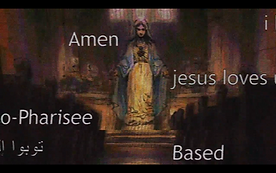


The memetic phrases overlaying the stream in the opening scene were inspired by danmaku (弾幕, meaning “bullet curtain” or “barrage”), a format seen on Japanese and Chinese video-sharing platforms where viewer comments scroll rapidly across the screen. I was interested in how this transforms media consumption into an overwhelming, collective experience, with layers of commentary competing for the viewer’s attention. In the context of my work, the effect reinforced themes of overstimulation, online spectatorship, and the fragmentation of attention within digital culture.


The frame organisation process became more complex as the animation developed, particularly because I kept adding additional in-between frames throughout production. This also meant I could not fully utilise some of the animation features in Clip Studio Paint due to the large number of correction layers active at once.


For the AI companion, I gave her a slight tan while keeping her ethnicity intentionally ambiguous, reflecting how idealised digital figures are often designed to be broadly appealing and universally marketable.
Her short dress and visible cleavage were intended to make the character subtly eroticised without becoming overtly pornographic.

I used text-to-speech voices generated through ElevenLabs for several character voices, as I did not know anyone whose voice suited the roles I had in mind. This allowed me to create more distinct characterisation.
The protagonist's voice is mine, and I experimented with Adobe Audition to improve the quality of my recordings as I only had access to the microphone built into my headphones. Since I was unfamiliar with the program, the improvements were fairly limited, so I compromised by editing the audio within Adobe After Effects, which helped reduce some of the background noise and static.
Some scenes required more in-depth thumbnailing to nail the compositions.